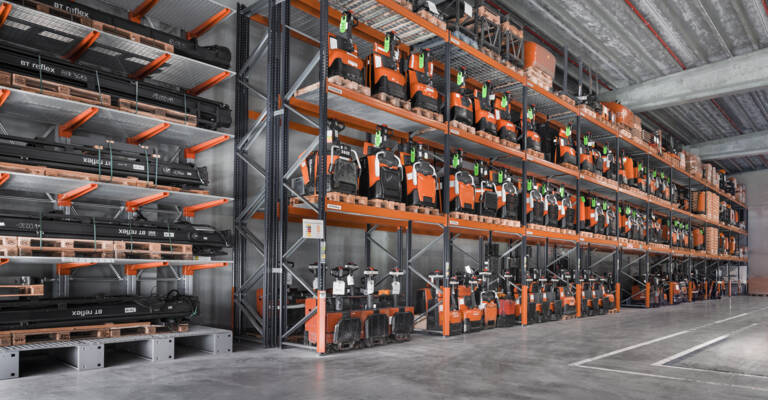
Warehouse space in Dubai is pretty expensive, just as any other property. As land costs have climbed and logistics operations have grown more complex, the pressure to extract more from the same footprint has become one of the defining challenges for warehouse managers across the region. The answer is to go vertical and narrow. And narrow aisle warehousing has become a mainstream consideration for any facility serious about storage density. The equipment has had to keep up, too. A skid steer loader maneuvering in a tight yard outside might seem a world away from what’s happening inside a VNA facility, but the logic is the same: go as tight as possible, and make sure your machines can still move.
Storage density has become the primary metric
The shift towards narrow aisle configurations is all about rethinking how a warehouse performs as an asset. A conventional wide aisle facility uses a significant proportion of its floor area for aisle space that exists solely to accommodate the mobility of counterbalance forklifts. That space isn’t generating any storage value. It’s built into the layout because the equipment demanded it.
Narrow aisle and very narrow aisle configurations challenge that assumption directly. These facilities run guided or semi-guided trucks through aisles that a standard forklift couldn’t even enter, and are able to recover floor area that conventional layouts surrender to equipment limitations.
At a facility of any meaningful size, that recovery translates into an increase in storage capacity that changes your whole operation. More pallets in the same building mean a lower cost per pallet stored, which, over the life of a lease or ownership period, is a significant financial gain.
And to really bring this shift about in your warehouse, you need to view it as a complete operational redesign. Aisle width, floor flatness tolerances, racking height, fire suppression configuration, and lighting. All of it needs to be realigned for a VNA operation to perform the way it’s supposed to, and the operations that have achieved that alignment are running at a storage density that their counterparts can’t match.
Floor flatness is where VNA operations succeed or fail
VNA trucks operating at height in aisles measured in millimetres of clearance are very sensitive to floor flatness. A deviation that a counterbalance forklift absorbs without the operator noticing becomes a stability and safety issue for a VNA truck working at eight or ten metres.
The floor flatness standards required for VNA operation are demanding, and achieving them in a new build is considerably easier than retrofitting an existing facility.
Operations that have tried to introduce narrow-aisle configurations into buildings with floors built to conventional tolerances have consistently found that the floor becomes the limiting factor for how far into the aisle they can push their equipment.
Getting the floor right from the start, or investing properly in remediation if retrofitting, is the foundation on which everything else sits, literally and operationally.
Reliability runs through every layer of the operation
A VNA facility running at high density and high throughput has very little tolerance for equipment downtime. The aisles are too narrow for one truck to pass another, so a breakdown in an aisle blocks access to an entire section of the racking until the machine is recovered. And the operational ripple from a single piece of equipment failure in a busy, narrow-aisle facility would be a massive dent in your daily schedule.
This is where the engineering quality of the equipment running these facilities matters beyond the basic specifications. The trucks inside a VNA facility get most of the attention, but the equipment supporting the operation from the outside is just as critical to maintaining throughput.
Yard tractors, reach stackers, and outdoor handling equipment running a John Deere engine manage the flow of goods into and out of the facility, and a breakdown at that stage backs up the whole chain.
A VNA operation running efficiently inside but struggling with yard equipment reliability outside is still a facility with a throughput problem. Internal and external operations are more closely linked than you’d think!
The VNA facility of tomorrow is already being built today
The next development in narrow aisle warehousing is the integration of automation into configurations that have historically been operator-dependent.
Fully automated storage and retrieval systems operating in very narrow aisles are already operational in high-volume distribution facilities globally, and the direction of travel in the GCC market is towards wider adoption of semi-automated and fully automated VNA configurations as the technology becomes more accessible and the labour-cost argument for automation strengthens.
The facilities being designed and built today with VNA in mind are increasingly incorporating automation infrastructure from the ground up, even where the initial operation will be manual. Building that flexibility at the design stage costs a fraction of what retrofitting it later would, and the operations thinking that far ahead is positioning itself for a major capacity advantage.